
Xenia Léonard
Business Payment Services
Fon. +49 681 383-1317
xenia.leonard@saarlb.de
xenia.leonard@saarlb.de



Since April 2024, a new regulation on real-time transfers (EU No. 2024/886) has been in force throughout the European Union. Its aim is to promote the use and acceptance of real-time transfers and to create uniform standards for greater security and efficiency in payment transactions. From 5 October 2025, the implementation of the regulation will bring important changes. In future, real-time transfers can be initiated not only in online banking or via EBICS, but also as a paper-based transfer. Depending on the procedure, individual and collective orders as well as standing orders and scheduled orders timed to the minute are available to you. Your orders are executed around the clock, with no amount limit and no additional costs. And the new verification of payee for transfers, real-time transfers and standing orders provides greater security. Before an order is executed, it will in future be checked whether the name of the payee entered matches the name held at the payee’s bank. But there is action to be taken. Find out here about the most important tasks for your company.
Under the regulatory requirements of the EU Regulation on real-time transfers, verification of payee (sometimes also referred to as IBAN name check or Verification of Payee (VoP)) must be implemented by 9 October 2025. In line with the requirements of the European Payments Council (EPC), the savings banks will activate verification of payee on 5 October 2025. There may be payee banks in the EU that do not activate verification of payee until after 5 October 2025. In the period from 5 to 9 October 2025, please expect a corresponding notification from verification of payee stating that the check is not possible for payments to these payee banks. It can be assumed that these notifications will gradually decrease by 9 October 2025.
With the new verification of payee, you as a corporate customer can protect yourself against fraud, incorrect invoices and input errors when executing a transfer. As the party ordering a payment, you can choose whether a verification of payee should be carried out (opt-in) or whether you do not want this (opt-out) for collective transfers and collective real-time transfers. A verification of payee must always be carried out for individual transfers. It is therefore essential to check internal processes! As the payee of a transfer order, it is important that your payers enter the correct name. A different name may result in the person ordering the payment not authorising the payment.
To open this document, please download it and use your Acrobat Reader.
In future, real-time transfers can be initiated via all the familiar channels – in online banking, via the EBICS procedure and also on paper.
As of October, real-time transfers can also be submitted as standing orders timed to the minute or scheduled orders. So you remain flexible.
In future, real-time transfers will be possible without an additional upper amount limit. Limits agreed in online banking or in the EBICS procedure remain in place.
A real-time transfer costs no more than a standard transfer.
Real-time transfers are possible any day and any time – even on public holidays and at weekends.
All transfers and real-time transfers must be checked in future. This also applies to collective, standing and scheduled orders.
As a corporate customer, you can waive the verification of payee for collective transfers and real-time collective transfers with multiple transactions.
In addition to their company name, corporate customers can also enter well-known trade names. These are also taken into account during the verification of payee.
Parties ordering a real-time transfer are informed within a very short time whether the transfer succeeded or failed.
Notification is provided free of charge where the order was placed – for example via the real-time transfer alarm clock in online banking or the status report in the EBICS procedure.
The following notifications are possible:
The IBAN entered and the name almost match.
The IBAN entered and the name almost match. The name of the payee at the payee bank is displayed.
The IBAN entered and the name almost match.
The verification could not be carried out for various reasons.
|
Scenario
|
Request
|
Notification
|
Notification
|
|---|---|---|---|
|
Correct name |
Max Mustermann |
Max Mustermann |
Match |
|
Multiple first names |
Max Mustermann |
Max Maximilian Mustermann |
Match |
|
Community persons |
Max Mustermann |
Max Mustermann und Maxima Mustermann |
Match |
|
Correct name, small typos |
Max Mustterman |
Max Mustermann |
Close match |
|
Initials |
Mustermann |
Max Mustermann |
Close match |
|
No first name |
Mustermann |
Max Musterman |
Close match |
|
Incorrect name |
Maria Mustermann |
Max Mustermann |
No match |
|
Trade name different from the name of the account holder |
Pizzeria Don Franesco |
Max Mustermann |
No match |
|
No answer received |
Max Mustermann |
Max Mustermann |
No verification possible |
|
Bank does not participate in verification of payee |
Max Mustermann |
Max Mustermann |
No verification possible |
Due to a publication by BaFin (https://www.bafin.de/ref/19976730), corporate customers may, until further notice, submit batch transfers with only one transaction via EBICS even without beneficiary verification (opt-out). For this purpose, you may continue to use the previously utilized order types until further notice.
Submission of the individual transfer in online banking or via EBICS.
Automatic check whether the payee name matches the account holder.
The result of the verification is reported back promptly.
Decision on authorisation or rejection of the payment based on the verification result, in online banking additionally the option to accept correction suggestions from close match.
- Individual transfer was authorised - Individual transfer was rejected.
As a corporate customer, however, you can decide whether the verification of payee is carried out (opt-in) or whether you waive the verification (opt-out) for collective transfers and collective real-time transfers with more than one transaction. In the EBICS procedure, a collective order can only be fully authorised or rejected after the name has been verified. It is not possible to authorise individual payments (partial authorisation) within a collective order. As the party ordering a transfer or real-time transfer, it is therefore important that you review your internal processes:

As the payee of a transfer and real-time transfer, it is therefore important that you inform all business partners in good time:
The implementation of verification of payee also entails technical adjustments in the EBICS procedure. New EBICS business transactions are being created for the submission of SEPA transfers and real-time transfers with verification of payee. If you wish to use verification of payee, or are required to do so by law (for example for individual transfers), please use the new business transactions in future. These will be available to you automatically from 5 October 2025.
|
Business transaction
|
BTF parameters (EBICS version 3.0)
|
EBICS order type (EBICS version 2.5)
|
|---|---|---|
|
SEPA transfer with verification of payee |
SCT//VOI/pain.001/ |
CTV |
|
SEPA real-time transfer with verification of payee |
SCI//VOI/pain.001/ |
CIV |
|
Verification of payee status report (pain.002) |
REP/DE/VOP/pain.002/ZIP |
VPZ |
If you do not wish to carry out a verification of payee, you can use the existing EBICS business transactions:
|
Business transaction
|
BTF parameters (EBICS version 3.0)
|
EBICS order type (EBICS version 2.5)
|
|---|---|---|
|
SEPA collective transfer without verification of payee |
SCT//VOO/pain.001/ oder SCT///pain.001 |
CCT |
|
SEPA collective transfer without verification of payee |
SCI//VOO/pain.001/ oder SCT///pain.001 |
CIP |
With verification of payee:
Without verification of payee:
The order must be executed as a real-time transfer with verification of payee (EBICS order type CIV):
NOTE: If the order is instead submitted without verification of payee (EBICS order type CIP), it will be rejected on the EBICS bank computer, as a verification of payee must always be carried out for individual real-time transfers.
The order must be executed as a SEPA transfer with verification of payee (EBICS order type CTV). SEPA collective transfers with only one single transaction will be executed as a single transfer in future, i.e. the verification of payee is mandatory. If the order is instead submitted without verification of payee (EBICS order type CCT), it will be rejected on the EBICS bank computer, as a verification of payee must always be carried out for individual transfers. Further detailed information can be found on the website of the German Banking Industry: https://www.ebics.de/de/ebics-standard/hinweise-hersteller-kunden
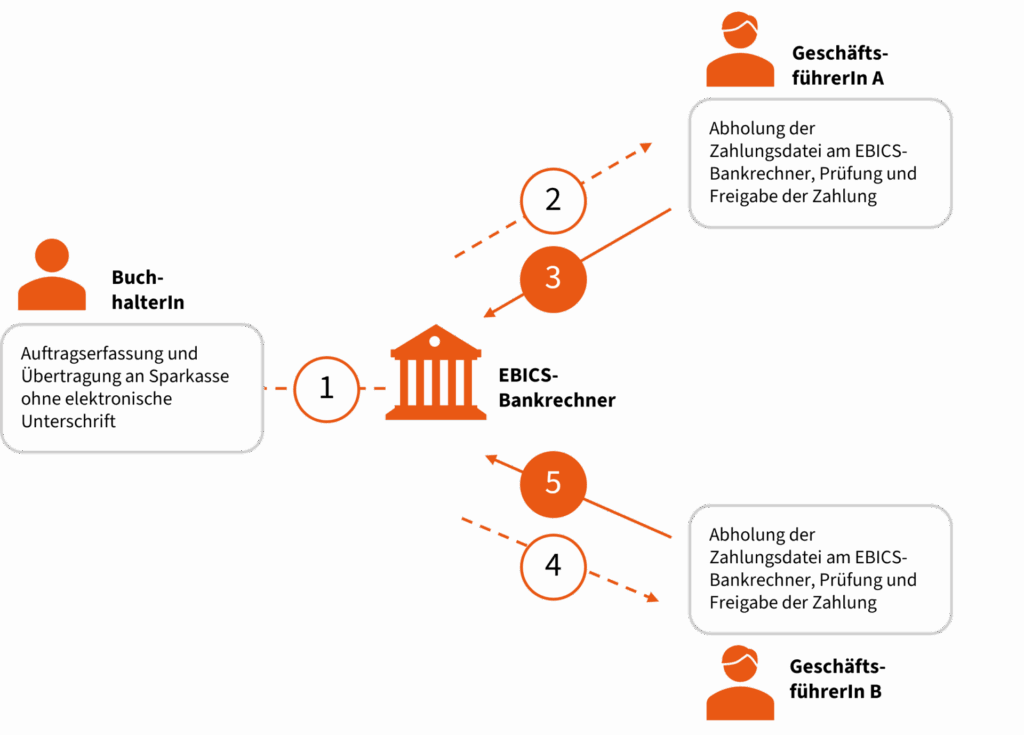
In future, use of the distributed electronic signature will be mandatory in order to release or cancel payment orders with verification of payee. The Instant Payments Regulation stipulates that all signatories must first take note of the VoP result. The submitted file that has undergone the VoP check is therefore authorised or cancelled via the distributed electronic signature (VEU). For this purpose, the VEU procedure is being extended to include the VoP check result and supplementary information. If you do not yet use the VEU, find out now how it works in the banking software or app you use.
The accountant submits the transfer order without an electronic signature and sends it to SaarLB. Managing director A retrieves the information on the transfer order from the EBICS bank computer and checks it. After the check, they add their electronic signature (ES) using banking software. Managing director B retrieves the information on the not yet fully signed transfer order from the EBICS bank computer and checks it. After the check, they in turn add their electronic signature (ES) using the EBICS app. The fully signed order is processed.
Please find out in good time whether the producer of your application will make the necessary adjustments so that you can use all the new functions. SaarLB will provide the payment transaction applications offered, such as SFirm and the online banking portal, with all necessary updates in good time. If you are using an application from another manufacturer, please contact them directly. At www.ebics.de/de/ebics-standard/implementation-guide you will find an implementation guide from the German Banking Industry for implementing the Instant Payment regulation in the EBICS procedure.
I do not want to use the verification of payee. What can I do?
For individual transfers or collective orders with only one transaction, verification of payee is mandatory and cannot be switched off. Corporate customers can optionally use verification of payee for collective transfers with more than one transaction.
I don’t know if my banking application supports verification of payee. What can I do?
Applications provided by SaarLB, such as online banking or SFirm, will support verification of payee in good time.
How can I stay informed about the status of my real-time transfers?
In online banking, you can find out about the status of your real-time transfer via your revenue display or the account alarm clock. In the EBICS procedure, you can track the status using your transaction information, earmarked items or the status report.
What happens if the transfer is not executed within ten seconds?
If a real-time transfer cannot be completed within ten seconds, the transferred amount is automatically credited back to your account. If, in exceptional cases, the execution status is still unclear after the deadline has expired, you will receive a corresponding notification together with the chargeback. In this case, please do not make a new transfer until SaarLB has finally checked the payment status.
Does the verification of payee also apply to express transfers and international payments?
No, euro express transfers and foreign payments are not subject to the verification of payee requirements and can be submitted as before.
Does the verification of payee also apply to payments to my own current accounts?
Irrespective of whether payments are made to one’s own payment accounts at SaarLB or at another credit institution, these are subject to the obligation to verify the payee. This does not apply to non-payment accounts, such as fixed-term deposits and savings accounts.


